The Order of Things: An Archaeology of Human Sciences by Foucault Michel
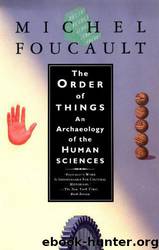
Author:Foucault, Michel [Foucault, Michel]
Language: eng
Format: epub, azw3
Tags: Science, Philosophy, Psychology, Non Fiction
Published: 2012-01-18T19:27:12+00:00
It would, no doubt, be impossible to avoid these fluctuations did there not exist in the order of things a contrary tendency, which ceaselessly aggravates the poverty of nations that are already poor and, on the other hand, increases the prosperity of states that are rich. For population tends to move in the contrary direction to money. The latter moves out from the prosperous states into the regions where prices are low; whereas men are attracted towards high wages, therefore towards countries that have an abundant coinage at their disposal. The poorer countries thus have a tendency to become depopulated; their agriculture and industries deter-iorate and poverty increases. In rich countries, in contrast, the influx of labour makes possible the exploitation of new wealth, the sale of which proportionately increases the amount of metal in circulation [52].
Governmental policy should therefore attempt to come to terms with these two contrary movements on the part of population and currency. The number of inhabitants must grow, gradually but uninterruptedly, so that manufacturing industries will always have an abundance of workers to draw on; then wages will not increase at a greater rate than wealth, nor prices with them; and the balance of trade will be able to remain favourable: one recognizes in all this the foundation of the populationist theses [53]. But, on the other hand, it is also necessary that the quantity of specie should be slightly but constantly on the rise: the only means of making sure that the products of the land or of industry will be well remunerated, that wages will be sufficient, and that the population will not be poverty stricken in the midst of the wealth it is creating: hence all the measures intended to encourage foreign trade and maintain a positive balance.
What ensures the equilibrium of the economy, therefore, and prevents profound fluctuations between wealth and poverty, is not a certain and definitively acquired economic constitution, but the balanced interaction -at once natural and deliberately maintained - of two tendencies. There is prosperity within a state, not when coin is plentiful and prices are high, but when the coinage has reached that stage of augmentation - which must be made to continue indefinitely - that makes it possible to maintain wages without increasing prices any further: this being so, the population grows at a steady rate, its work constantly produces more, and, since each consecutive increase in the coinage is divided up (in accordance with the law of representativity) between small quantities of wealth, prices will not increase in relation to those in force abroad. It is only between an increase in the quantity of gold and a rise in prices that an increasing quantity of gold and silver encourages industry. A nation whose coinage is in process of diminution is, at any given moment of comparison, weaker and poorer than another nation which has no greater possessions but whose coinage is in process of growth. This is the explanation of the Spanish disaster: its mining
Download
The Order of Things: An Archaeology of Human Sciences by Foucault Michel.azw3
This site does not store any files on its server. We only index and link to content provided by other sites. Please contact the content providers to delete copyright contents if any and email us, we'll remove relevant links or contents immediately.
| Anthropology | Archaeology |
| Philosophy | Politics & Government |
| Social Sciences | Sociology |
| Women's Studies |
The remains of the day by Kazuo Ishiguro(8999)
Tools of Titans by Timothy Ferriss(8396)
Giovanni's Room by James Baldwin(7346)
The Black Swan by Nassim Nicholas Taleb(7129)
Inner Engineering: A Yogi's Guide to Joy by Sadhguru(6796)
The Way of Zen by Alan W. Watts(6614)
The Power of Now: A Guide to Spiritual Enlightenment by Eckhart Tolle(5782)
Asking the Right Questions: A Guide to Critical Thinking by M. Neil Browne & Stuart M. Keeley(5775)
The Six Wives Of Henry VIII (WOMEN IN HISTORY) by Fraser Antonia(5515)
Astrophysics for People in a Hurry by Neil DeGrasse Tyson(5190)
Housekeeping by Marilynne Robinson(4448)
12 Rules for Life by Jordan B. Peterson(4305)
Ikigai by Héctor García & Francesc Miralles(4274)
Double Down (Diary of a Wimpy Kid Book 11) by Jeff Kinney(4272)
The Ethical Slut by Janet W. Hardy(4253)
Skin in the Game by Nassim Nicholas Taleb(4250)
The Art of Happiness by The Dalai Lama(4130)
Skin in the Game: Hidden Asymmetries in Daily Life by Nassim Nicholas Taleb(4007)
Walking by Henry David Thoreau(3962)
